The Secondary Circulation of the Quasibiennial Oscillation
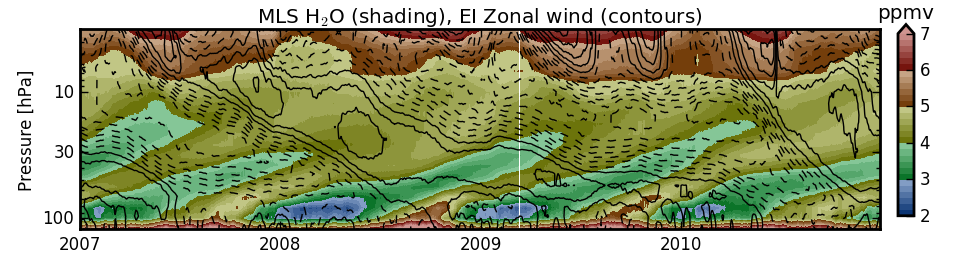
The plot above shows two basic features of the tropical lower stratosphere. In the coloured contours, we see the tropical 'tape-recorder': water vapour anomalies that are determined by the seasonal cycle in temperature at the tropical tropopause (just above 100 hPa). The temperatures there are lowest in Nothern Hemisphere in the winter, when observations show less than 3 ppm by volume of water vapour. These anomalies are then advected upwards by the Brewer-Dobson circulation, the global overturning circulation in the stratosphere that brings air up from the tropics and out to the poles.
The contour lines, in contrast, show eastward winds, which reveal the remarkably regular pattern of downward-migrating eastward and westward jets called the quasibiennial oscillation (QBO). In contrast to the annual periodicity of the water vapour, the period of the zonal winds is roughly 28 months, a time scale unrelated to the orbital parameters of the Earth.
Looking at these two features simultaneously makes clear the fact that the descending wind patterns of the QBO are 'running down the up-escalator.' Their descent in the reference frame of the tropical upwelling revealed by the water vapour measurements is substantially faster than in a reference frame fixed to the planet's surface. If one looks more closely, one can see that this descent is in fact not constant: levels where the winds are becoming more eastward with height (from dashed to solid contours) tend to descend more quickly, while levels where the winds become more westward with height (from solid to dashed contours) tend to desend more slowly. The upward advection of water vapour anomalies reveals a similar pattern: faster ascent in eastward transition zones and slower ascent in westward transitions. This is a result of the secondary circulation of the QBO: a pattern of meridional circulation cells with vertical motion on the equator that close in the subtropics. The origin of this secondary circulation is understood to be predominantly a result of the radiative heating associated with temperature anomalies in thermal wind balance with the eastward and westward jets (see, e.g. Plumb and Bell 1982).
Ozone and the Quasibiennial Oscillation
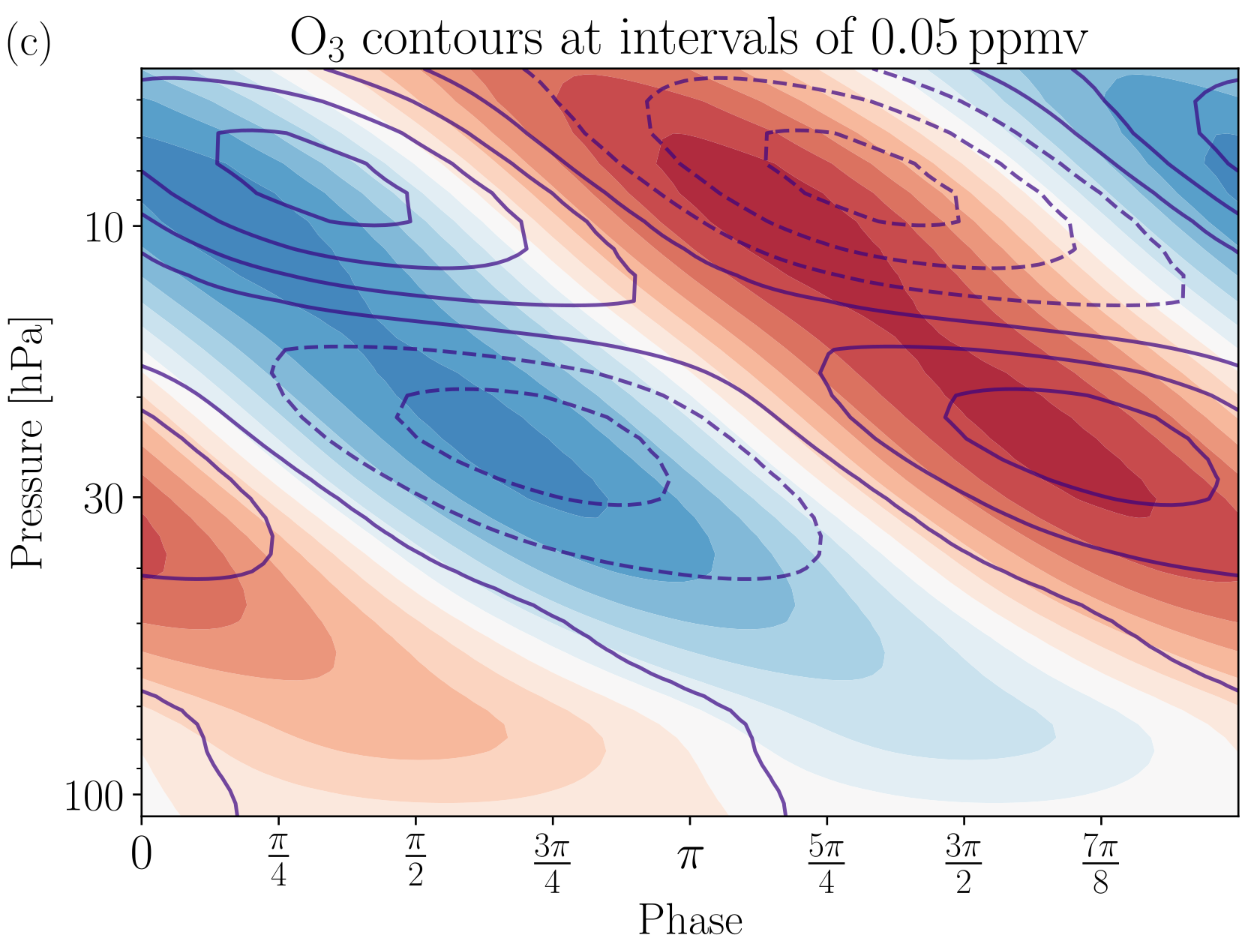
The QBO and its secondary circulation leaves its imprint on other trace gas species in the tropical stratosphere, most notably ozone. QBO-related variability in the ozone has a sharp transition around 12 hPa or so: its phasing relative to the winds and temperatures of the QBO are nearly completely reversed. This transition coincides with a change in the dominant processes that control ozone variability: below, ozone lifetimes are long and transport plays a major role, while above the photochemistry is fast and the ozone is in local photochemical equilibrium.
The basic understanding of the radiative origins of the secondary circulation have remained more or less unchanged since the early 1980s, while the processes that control the ozone QBO have been known since the mid-1990s. However, until recently the two have not been considered simultaneously. Surprisingly, we have shown that including the radiative effects of ozone in the dynamical theory for the secondary circulation of the QBO has a leading order effect: the tendency for ozone to be correlated with temperatures in the lower part of the QBO means that the radiative effects of the two tend to cancel one another out, suppressing the diabatic forcing of the secondary circulation (Hitchcock and Ming, in press).
To explain the observed secondary circulation, then, requires a very careful understanding of the ozone budget in the tropical lower stratosphere. The photochemical source of ozone, while often neglected as being weak compared to the effects of transport, becomes critical to include. However, the relevant photochemistry gets complicated quickly, and is determined to a considerable extent by the ozone column above. This suggests that understanding the ozone in the upper part of the QBO might be critical to understanding the evolution of the lower tropical stratosphere.
Beyond being an interesting and new development in our undersatnding of the dynamics of the QBO, this is likely to be important for improving model representation of the QBO in the lowermost stratosphere where it seems to have an impact on the tropical troposphere through the Madden Julian Oscillation. We are now working on a framework for assessing this interactions in chemistry climate models to better understand the connection between ozone chemistry and the QBO.